Notes ·
pasteur.la: a research institute's website that has run on the same WordPress foundation since 2011
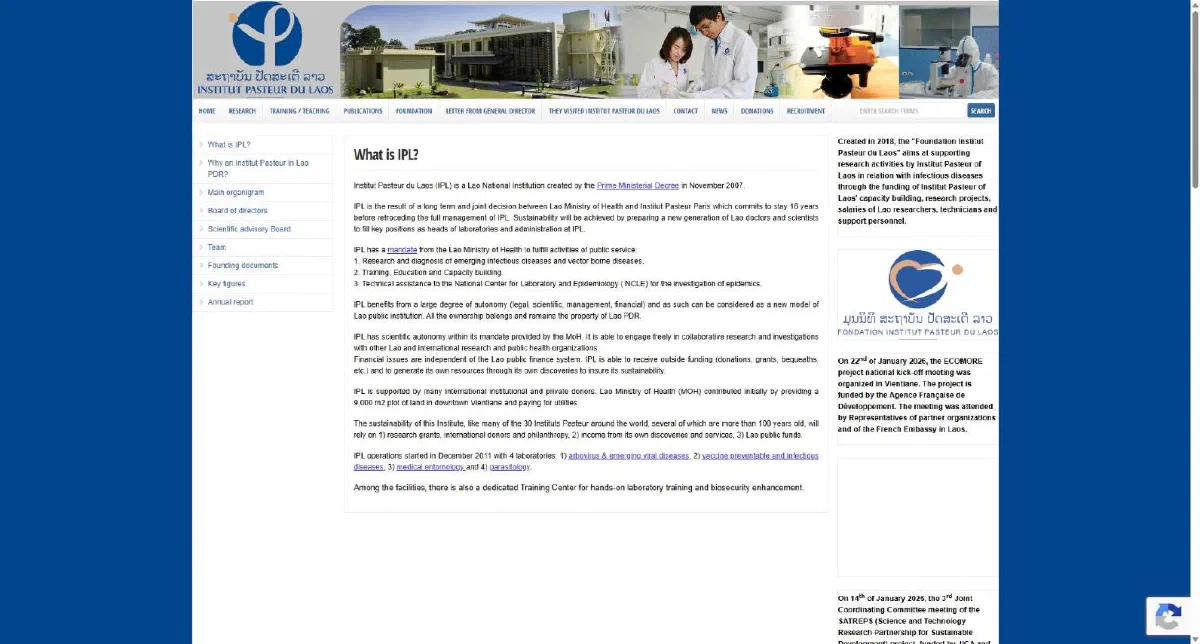
Most websites are rebuilt every few years. The one I built for the Institut Pasteur du Laos in 2011 is still running — on the same platform and the custom theme I developed for it. This is the story of that site, and why I think it lasted.
The institute
The Institut Pasteur du Laos (IPL) is a Lao national institution, created by Prime Ministerial Decree in November 2007 as a joint initiative of the Lao Ministry of Health and the Institut Pasteur in Paris. Its laboratories began operating in December 2011, with four research units: arbovirus and emerging viral diseases, vaccine-preventable and infectious diseases, medical entomology, and parasitology. It is one of around 30 Instituts Pasteur around the world.
I joined IPL in 2010, first as Data Manager and then as IT Manager and Building Facility Manager. Alongside the servers, the network and the construction of the new BSL-2+ laboratory, the institute needed a public face that matched the quality of its science — just as its laboratories were opening.
What I built
- The institute’s official website on WordPress, with a custom theme designed for IPL, launched in 2011.
- A structure that researchers and administration could keep up to date themselves — news, research, publications, training and recruitment — without calling a developer for every change.
- Day-to-day leadership of the site until 2015, including supervising the media creation specialist who produced its content and visual material.
Why WordPress
For an organisation whose core business is science, not software, the platform had to be:
- Easy to edit by non-technical staff.
- Widely supported, so the institute would never depend on one person to keep it alive.
- Extensible as needs grew — new sections, new languages, new research units.
Fifteen years later
Today the site is bilingual (English and French) and covers the institute’s research units, publications, news, annual reports, recruitment and donations. The content has grown with the institute, but the foundation laid in 2011 — the platform and the custom theme — still carries it.
What I learned
- Choose the platform for the people who will maintain it, not for the person who builds it.
- A website is a process, not a project. Training editors and setting simple publishing habits mattered more than any feature.
- Boring technology lasts. A mainstream, well-supported platform outlived every trend of the last fifteen years.
Building or rescuing a website for an organisation that isn’t in the software business? I’d be glad to help — through the contact form or via Vangera Systems. You can also read about another project of mine: Landfill, a weighbridge billing system for a provincial landfill.